



How does the preclinical testing of dental implants at INNOPROOF work?
Below, we present our capabilities for the preclinical testing of dental implants and related instruments. The most important mechanical test is the fatigue test according to ISO 14801:2017. This testing method can also be adapted for bridge constructions. More information can be found below by clicking on the respective sections. In addition to the ISO 14801 test, we offer accredited torsion tests on dental implants according to ISO/TS 13498.
What about surgical instruments? Are you aware of how long torque wrenches last and how precise the torque display remains after numerous uses? To answer these questions, we provide corresponding accredited tests according to ISO 11953.
If you are interested in tests related to endodontics, please also check our “Surgical Instruments” section, where we offer testing of dental files according to ISO 3630-1.
Please contact us or use the call-back function so we can prepare a tailored offer for you.
The methods accredited within our scope are marked with *.
Procedures for the mechanical testing of dental implantology
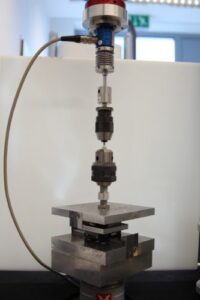 The torsion test according to ISO/TS 13498 evaluates the torsional strength and maximum torque of implants or articulated connecting components of dental endosseous implant systems. This test is especially suitable for evaluating novel joint types, connectors, and new materials. The test is conducted at room temperature in air and should, as far as possible, simulate the clinical use of the implant. That is, specimens representative of the finished product are tested and sterilized as required according to the manufacturer's instructions.
The maximum torque is determined on at least six identical specimens by clamping the sample into the testing machine and applying torque at a rate of one to ten degrees per minute. The torsional strength is determined at a rotation angle of 2°. During the test, a curve is recorded showing torque as a function of rotation angle, from which the maximum torque and torsional strength can be graphically determined. Broken or deformed parts of the implant are subsequently examined under a low-magnification microscope and documented in the test report.
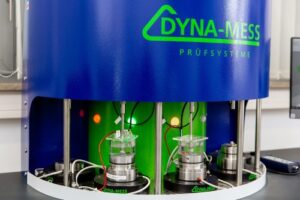 DIN EN ISO 14801 describes a test method for fatigue (failure) of single-piece endosseous dental implants of various sizes and designs. The test should, as far as possible, simulate the clinical use of the implant, meaning that specimens representative of the finished product are tested and sterilized as required according to the manufacturer's instructions. For testing, the specimen is rigidly clamped in the testing machine depending on the design (angled or non-angled abutments) and subjected to a uniaxial load for a defined number of cycles. To create a worst-case scenario, the implant is tilted by 30° during testing.
Additionally, the critical failure point and location are determined, which characterize permanent deformation, loosening of the implant assembly, or fracture of a component. If the implants contain corrosion-prone components or polymers, testing must be conducted in physiological saline solution at 37°C. For all other implant compositions, testing is performed in air at room temperature. All results are documented in a test report according to the standard.