
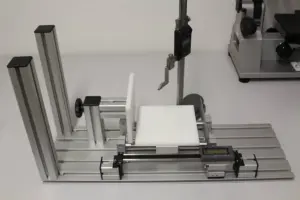
 Für die morphologische Analyse wurde ein Prüfstand auf der Grundlage von Jewell et al. 2018 aufgebaut. Der Prüfstand besteht aus einem Schiebetisch, der die Brustimplantatprobe trägt. Der Schiebetisch wird so bewegt, dass der Prüfling den stationären Plattenanschlag berührt. Der bewegliche Plattenanschlag ist mit einem horizontalen Messschieber verbunden, um die Breite des Implantats zu messen. Ein digitaler Höhenindikator ist neben dem Aufbau angebracht, um die Projektion und die Poltiefe zu messen. Der Aufbau ermöglicht auch eine unterstützte vertikale Ausrichtung des Prüfkörpers.
Zu den gemessenen Parametern gehören die Breite, die Höhe, die untere Poltiefe und die obere Poltiefe bei anatomisch geformten Implantaten und die Höhe, der Überstand und die obere Poltiefe bei runden Implantaten. Jeder Parameter wird für jede Vorrichtung dreimal gemessen, wobei das Implantat zwischen den Messungen aus dem Prüfgerät entfernt und neu positioniert wird. Die maximale Projektion bei anatomisch geformten Implantaten ist definiert als die Tiefe des unteren Pols in horizontaler Position, und die maximale Projektion bei runden Implantaten ist definiert als der Apex in der Mitte der Vorrichtung. Die Tiefe des oberen Pols ist die Dicke des oberen Pols, die definiert ist als 17 % der mittleren horizontalen Höhe, gemessen von der Oberseite eines anatomisch geformten Implantats, bzw. 25 % der mittleren horizontalen Höhe, gemessen von der Oberseite eines runden Implantats.
Referenz: Jewell ML, Bengtson BP, Smither K, Nuti G, Perry T. Physical Properties of Silicone Gel Breast Implants. Aesthet Surg J. 2019 Feb 15;39(3):264-275